- Home
- Blog Details
In a groundbreaking discovery, an international team of astronomers, led by the University of Cambridge, has detected the oldest black hole ever observed. This cosmic behemoth dates back more than 13 billion years, to the very dawn of the universe. Their findings, published in the journal Nature, challenge our existing assumptions about black hole formation and growth.
The Ancient Black Hole
Discovery Details:
Using the powerful NASA/ESA/CSA James Webb Space Telescope (JWST), scientists pinpointed this ancient black hole. It resides at the heart of a compact galaxy called GN-z11, which is approximately one hundred times smaller than our Milky Way. The black hole’s existence so early in the universe defies conventional models of its formation.
Size and Vigorous Appetite:
This surprisingly massive black hole weighs in at a few million times the mass of our Sun. Unlike its later-born counterparts, it seems to be voraciously consuming matter from its host galaxy. Its rapid feeding rate challenges our understanding of black hole growth.
Birth and Buffet:
Standard models suggest that supermassive black holes form from remnants of dead stars, collapsing to about a hundred times the Sun’s mass. However, this newly-detected black hole would have taken a billion years to grow to its observed size if it followed the expected path.The early universe, rich in gas, likely served as a cosmic buffet for these fledgling black holes.
Glowing Evidence:
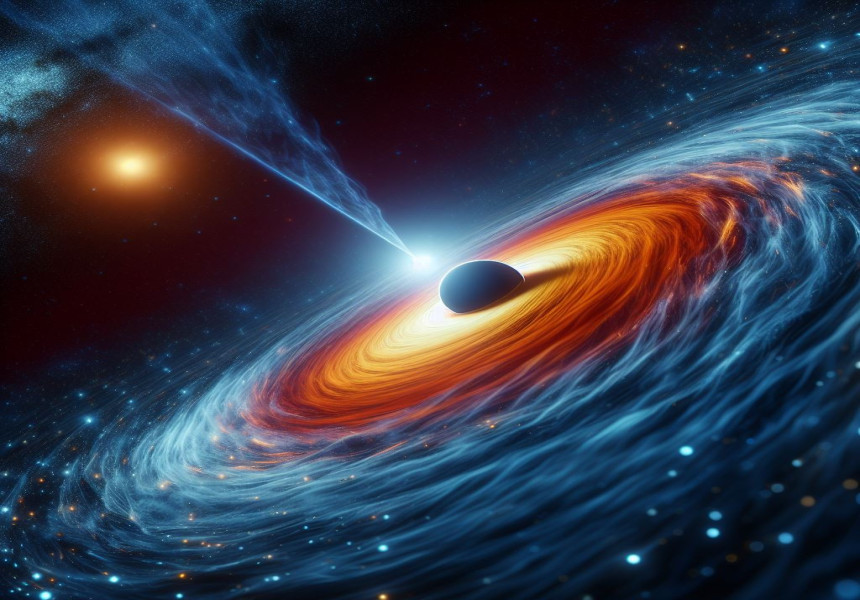
Black holes themselves remain invisible, but their presence is revealed by the glow of swirling accretion discs near their edges.As matter spirals into the black hole, it heats up and emits energy in the ultraviolet range. GN-z11’s energetic glow confirms the black hole’s voracious appetite.
Conclusion:
GN-z11’s development is likely hindered by its central black hole’s relentless feeding. When black holes consume excessive gas, they create an ultra-fast wind that pushes away vital galactic material. In unraveling the mysteries of this ancient cosmic devourer, astronomers take a giant leap forward. As we peer across billions of years, we glimpse the universe’s tumultuous infancy—a time when black holes feasted upon primordial gas, shaping the cosmos we know today.